
What is a Blood Moon?
“Blood Moon” is a popular name for the Moon during the total stage of a lunar eclipse. The colour can range from copper and orange to deep red, depending on Earth's atmosphere and the observer's viewing conditions.
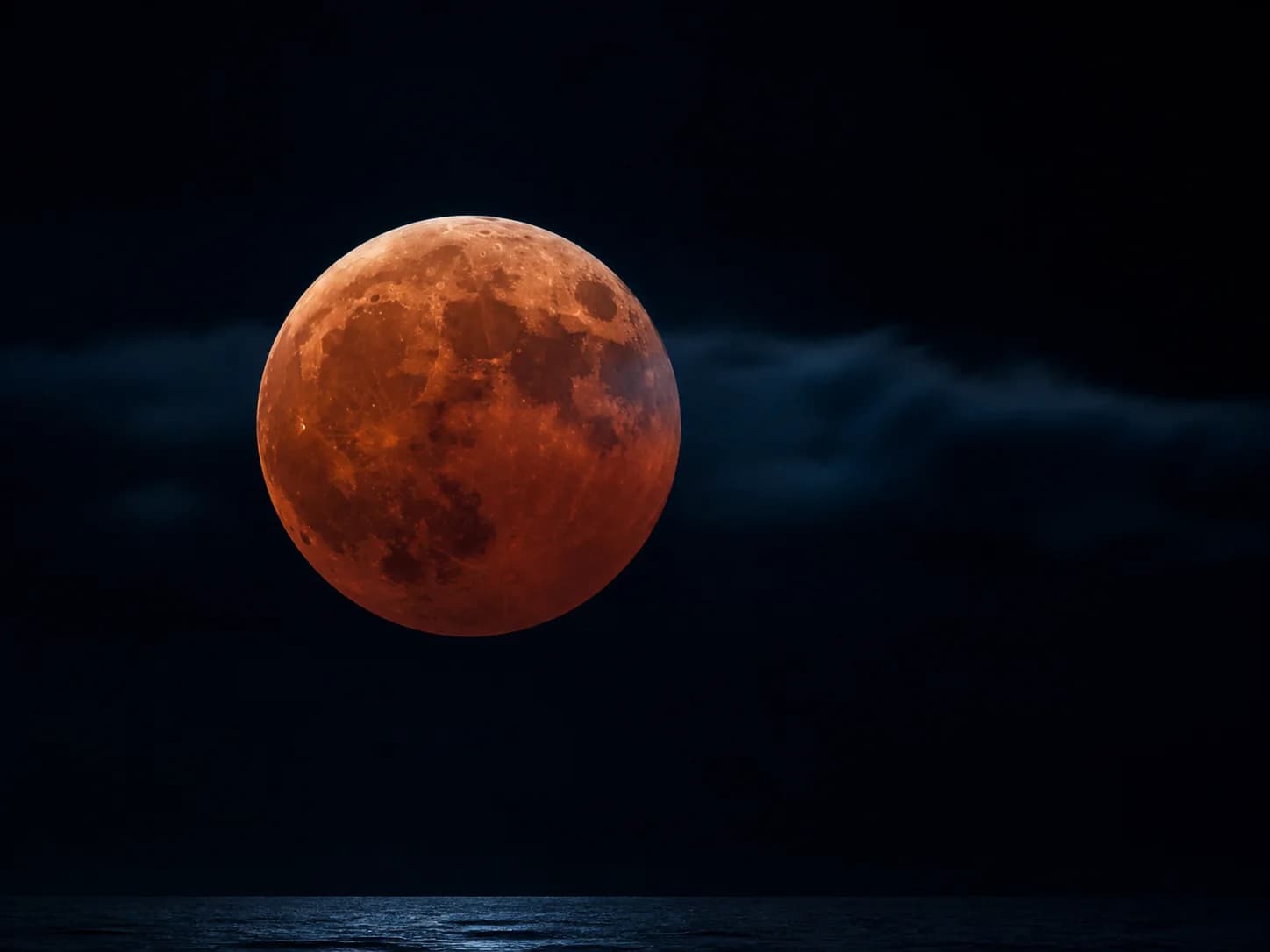
Why the eclipsed Moon looks red
Earth blocks direct sunlight from reaching the Moon during totality. Some sunlight passes through the edge of Earth's atmosphere, where shorter blue wavelengths are scattered more strongly. The remaining red and orange light is refracted into Earth's shadow and illuminates the Moon.
The result is not one fixed shade. Dust, cloud and aerosols in Earth's atmosphere affect the eclipse, while cameras record different colours according to exposure, white balance, lens and image processing.
Common misconception
Is every full Moon a Blood Moon?
No. A lunar eclipse requires the Sun, Earth and Moon to align closely enough for the Moon to cross Earth's shadow. Most full Moons pass north or south of that shadow because the Moon's orbit is tilted relative to Earth's orbit around the Sun.
Our Moon phase schedule shows full Moon dates, but a phase calendar alone cannot establish whether an eclipse occurs or where it is visible.
Next total lunar eclipse
Sun, 31 Dec 2028
Totality lasts about 72 minutes worldwide. Visible at maximum across all sampled UK locations.
Upcoming lunar eclipses
Dates, duration and UK visibility
The visibility summary tests whether the Moon is above the horizon during any part of the global eclipse at 18 locations across England, Scotland, Wales and Northern Ireland.
Lunar Penumbral lunar eclipse
- Global maximum
- 20 February 2027 at 23:12 GMT
- UK model
- Visible at maximum across all sampled UK locations.
- Penumbral span
- 242 min
- Partial span
- None
- Totality
- None
Modelled locations with some visibility: London, Birmingham, Manchester, Leeds, Liverpool, Bristol, Newcastle upon Tyne, Norwich, Plymouth, Cardiff, Swansea, Edinburgh, Glasgow, Aberdeen, Inverness, Belfast, Londonderry, Lerwick.
Lunar Penumbral lunar eclipse
- Global maximum
- 18 July 2027 at 17:02 BST
- UK model
- Below the horizon across the sampled UK locations.
- Penumbral span
- 25 min
- Partial span
- None
- Totality
- None
Lunar Penumbral lunar eclipse
- Global maximum
- 17 August 2027 at 08:13 BST
- UK model
- Below the horizon across the sampled UK locations.
- Penumbral span
- 220 min
- Partial span
- None
- Totality
- None
Lunar Partial lunar eclipse
- Global maximum
- 12 January 2028 at 04:13 GMT
- UK model
- Visible at maximum across all sampled UK locations.
- Penumbral span
- 251 min
- Partial span
- 58 min
- Totality
- None
Modelled locations with some visibility: London, Birmingham, Manchester, Leeds, Liverpool, Bristol, Newcastle upon Tyne, Norwich, Plymouth, Cardiff, Swansea, Edinburgh, Glasgow, Aberdeen, Inverness, Belfast, Londonderry, Lerwick.
Lunar Partial lunar eclipse
- Global maximum
- 6 July 2028 at 19:19 BST
- UK model
- At least part is visible from 11 of 18 sampled UK locations.
- Penumbral span
- 311 min
- Partial span
- 143 min
- Totality
- None
Modelled locations with some visibility: London, Birmingham, Manchester, Leeds, Liverpool, Bristol, Newcastle upon Tyne, Norwich, Plymouth, Cardiff, Swansea.
Lunar Total lunar eclipse
- Global maximum
- 31 December 2028 at 16:51 GMT
- UK model
- Visible at maximum across all sampled UK locations.
- Penumbral span
- 337 min
- Partial span
- 209 min
- Totality
- 72 min
Modelled locations with some visibility: London, Birmingham, Manchester, Leeds, Liverpool, Bristol, Newcastle upon Tyne, Norwich, Plymouth, Cardiff, Swansea, Edinburgh, Glasgow, Aberdeen, Inverness, Belfast, Londonderry, Lerwick.
Lunar Total lunar eclipse
- Global maximum
- 26 June 2029 at 04:22 BST
- UK model
- At least part of the event is visible across all sampled UK locations.
- Penumbral span
- 336 min
- Partial span
- 220 min
- Totality
- 103 min
Modelled locations with some visibility: London, Birmingham, Manchester, Leeds, Liverpool, Bristol, Newcastle upon Tyne, Norwich, Plymouth, Cardiff, Swansea, Edinburgh, Glasgow, Aberdeen, Inverness, Belfast, Londonderry, Lerwick.