
One orbit · changing light
Moon phases explained
A Moon phase describes the illuminated fraction of the lunar disc visible from Earth. The cycle is continuous; the eight familiar names divide it into useful calendar sections.
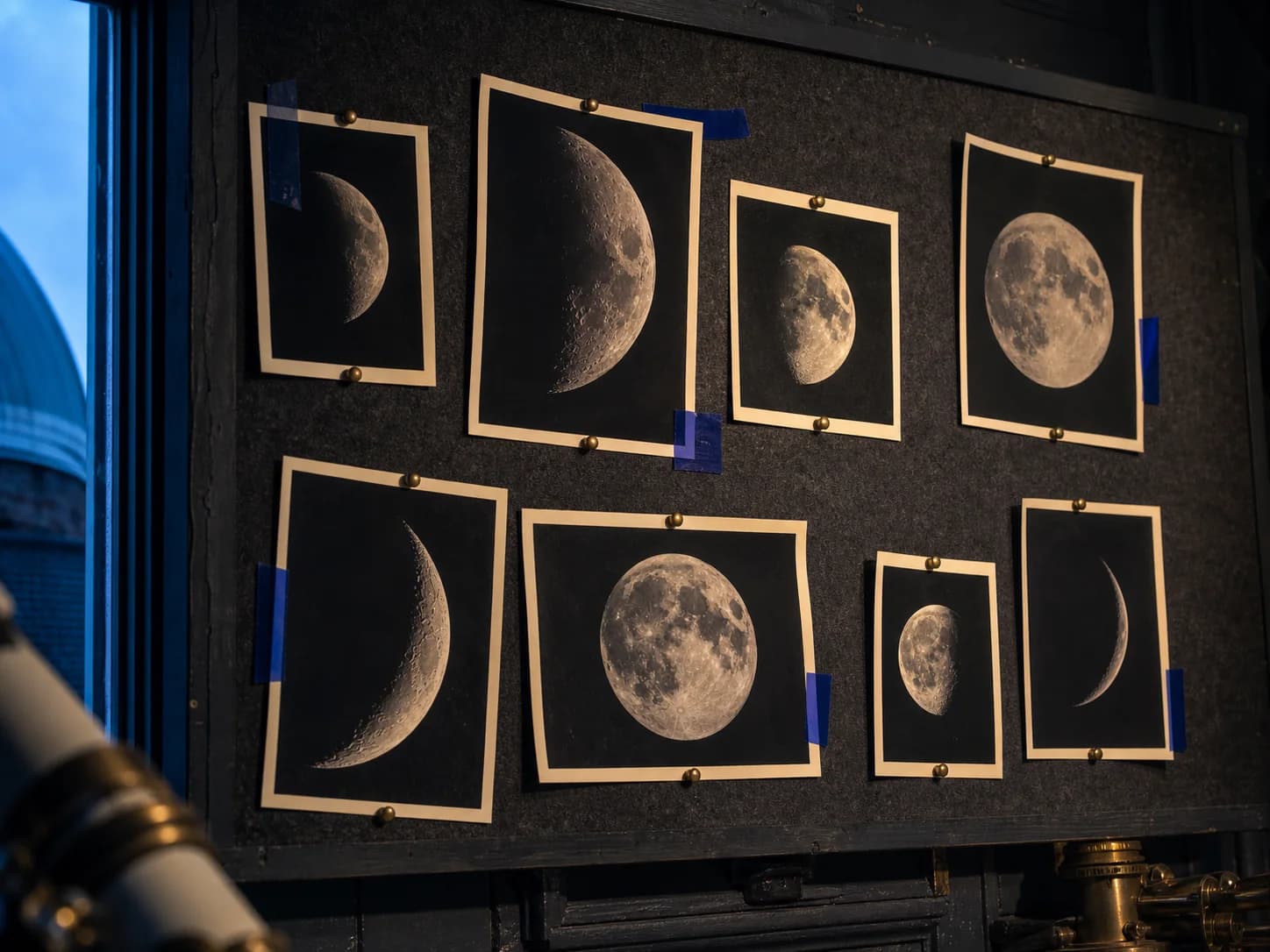
The eight common Moon phases
- New Moon
The sunlit half faces away from Earth, leaving the near side dark.
- Illumination
- 0–4%
- Calendar span
- About 3.7 days in this eight-part calendar; exact new Moon is one instant.
- Best visibility
- It rises and sets close to the Sun and is normally lost in daylight.
- Traditional association
- Traditionally used for planning, clearing space and beginning a cycle.
Previous: Waning Crescent · Next: Waxing Crescent
Next new moon instant: . Open date
- Waxing Crescent
A slim lit curve grows broader on successive evenings.
- Illumination
- 4–31%
- Calendar span
- About 3.7 days, from the first visible crescent towards first quarter.
- Best visibility
- Low in the western sky after sunset, setting later each evening.
- Traditional association
- Often associated with first steps, sowing and building momentum.
Previous: New Moon · Next: First Quarter
Next waxing crescent centre (45° sector): . Open date
- First Quarter
Half of the visible disc is lit at the exact quarter.
- Illumination
- 31–69% (50% at the exact quarter)
- Calendar span
- About 3.7 days as a phase label; the 90-degree quarter is an instant.
- Best visibility
- Rises around midday, stands high near sunset and sets around midnight.
- Traditional association
- Traditionally linked with decisions, action and overcoming resistance.
Previous: Waxing Crescent · Next: Waxing Gibbous
Next first quarter instant: . Open date
- Waxing Gibbous
More than half is illuminated and the bright area is still growing.
- Illumination
- 69–96%
- Calendar span
- About 3.7 days on the approach to full Moon.
- Best visibility
- Visible from afternoon through much of the evening and after midnight.
- Traditional association
- Often used as a prompt to refine, prepare and bring work towards completion.
Previous: First Quarter · Next: Full Moon
Next waxing gibbous centre (45° sector): . Open date
- Full Moon
The near side is almost completely illuminated, brightest at the exact opposition.
- Illumination
- 96–100%
- Calendar span
- About 3.7 days in the calendar label; exact full Moon is one instant.
- Best visibility
- Rises near sunset, crosses the sky overnight and sets near sunrise.
- Traditional association
- Traditionally associated with completion, attention and harvest.
Previous: Waxing Gibbous · Next: Waning Gibbous
Next full moon instant: . Open date
- Waning Gibbous
More than half remains lit, but the bright fraction shrinks each day.
- Illumination
- 69–96%
- Calendar span
- About 3.7 days after full Moon.
- Best visibility
- Rises during the evening and remains prominent in the morning sky.
- Traditional association
- Often linked with reviewing, sharing and reducing what is no longer needed.
Previous: Full Moon · Next: Last Quarter
Next waning gibbous centre (45° sector): . Open date
- Last Quarter
Half of the disc is lit at the exact 270-degree quarter while waning.
- Illumination
- 31–69% (50% at the exact quarter)
- Calendar span
- About 3.7 days as a phase label; the exact quarter is an instant.
- Best visibility
- Rises around midnight, is high near dawn and remains visible into morning.
- Traditional association
- Traditionally used for pruning, reassessment and finishing practical work.
Previous: Waning Gibbous · Next: Waning Crescent
Next last quarter instant: . Open date
- Waning Crescent
A narrowing crescent approaches the dark new-Moon alignment.
- Illumination
- 4–31%
- Calendar span
- About 3.7 days before the next new Moon.
- Best visibility
- Low in the eastern sky before sunrise and harder to see each morning.
- Traditional association
- Often associated with rest, maintenance and preparing for the next cycle.
Previous: Last Quarter · Next: New Moon
Next waning crescent centre (45° sector): . Open date
How long is a lunar cycle?
The phase angle 211.640° at 2026-10-28 12:00 repeats on 26 November 2026 at 20:49 GMT: 29.36793 days later.
| Period | Mean days | Returns to |
|---|---|---|
| Synodic | 29.53059 | Same Sun–Moon angle |
| Sidereal | 27.32166 | Same direction against the stars |
| Anomalistic | 27.55455 | Perigee |
| Draconic | 27.21222 | Ascending orbital node |
| Tropical | 27.32158 | Same equinox-based longitude |
The moving Earth, orbital nodes and perigee make these periods differ. Actual phase cycles vary around the mean. NASA’s lunar orbit reference.
01
Waxing, waning and illumination
Waxing means the illuminated fraction is increasing; waning means it is decreasing. Illumination is a percentage, while phase angle records the Moon's position in the cycle. Two dates can have similar illumination but opposite directions.
02
Using the phase names in a calendar
The monthly Moon calendar calculates a phase at local noon for each date. Exact new, quarter and full Moon instants appear separately in the phase schedule. For the live state, open today's Moon phase.